Getting to the point: demystifying the acupuncture needle
One of the most common barriers to folks getting acupuncture is cost which, here at Heart & Hands, we address by offering our $30-60 sliding scale.
I’m sure you guessed the second most common barrier, yes, a fear-of or aversion to needles…
“I don’t like needles”
We can thank the medical system for traumatizing countless folks with painful blood draws, vaccinations and IVs. Many struggle with separating the medical experience from needling in other settings, which is a shame. Acupuncture needles feel nothing like a hypodermic needle and here at H&H, we’ve helped so many folks recover from former fears, all while they receive the clinical benefits acupuncture has to offer.
And sometimes it’s really mind over matter; if it helps we can reframe the situation to focus on the outcome rather than the tools (the needles). What’s more, the whole process of receiving acupuncture is extremely versatile, from formulation of point combinations, depth, number of points as well as the length of the session. So, even the process of receiving needles can mostly be modified based on a client’s individual needs. As Christina Chan, R.Ac. one of our H&H acupunks regularly reminds clients, “You’re not getting acupuncture FOR the needles, you’re getting acupuncture for WHAT the needles do.” If you’re someone who is a little squeamish about it, thinking about it in this context might put your mind at ease.
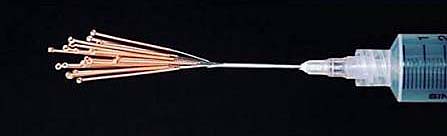
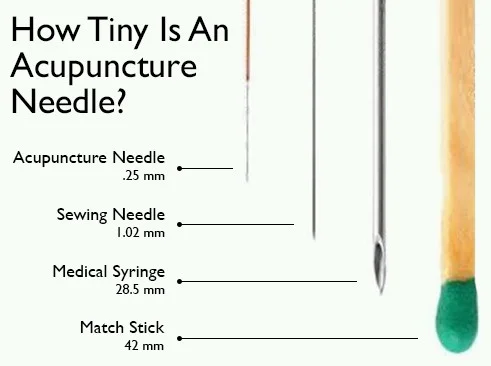
We also regularly let folks see and handle our needles to help demystify and better understand how tiny the 0.18mm x 30mm gauge needles are that we use on a daily basis. Amazingly as fine as a human hair and almost as flexible, depending on the gauge, approximately 20 to 30 acupuncture needles can fit inside the hollow shaft of a standard hypodermic needle.
So how does acupuncture work?
Truly, it never ceases to amaze us how these hair-thin needles have such a profound and deep effect on our bodies. Upon insertion, filiform acupuncture needles can stimulate sensory nerves, thereby triggering biochemical and neurological pathways that alter the perception of pain and promote healing.
The 12 primary meridians of the body run in parallel with nerve pathways, blood vessels, lymphatics and muscle chains, so it’s unsurprising that acupuncture points have been shown to stimulate many different systems of the body, including the central nervous system. The physiological processes that follow involve the release of transmitter chemicals into the muscles, spinal cord, and brain that promote the body’s natural healing abilities AKA stimulating and regulating the flow of Qi and Blood.
The effects of this are multifold, influencing neurophysiological and biochemical functions, which is why acupuncture can benefit so many conditions from pain management, digestive, respiratory, menstrual, reproductive and mental health and so much more!
Here are a number of the documented scientific effects of what happens when an acupuncture needle is inserted:
- Improved Blood Flow: imaging studies show that needling increases local microcirculation, which enhances the delivery of oxygen and nutrients to damaged tissues.
- Nervous System Activation: when a needle is inserted across the skin, it stimulates sensory nerve endings in the skin and muscles, sending electrical signals to the spinal cord and brain.
- Endorphin Release: nerve stimulation from acupuncture stimulates the central nervous system to release natural pain-relieving chemicals, endorphins and enkephalins.
- Adenosine Accumulation: from the rotation or insertion of acupuncture needles, this results in microscopic trauma to the tissue and subsequently the release of natural local pain-relieving compound, adenosine.
- Brain Activity Modulation: functional MRI scans indicate that acupuncture changes brain activity in the regions responsible for processing pain, stress, and emotional regulation.
- Regulation of the Autonomic Nervous System: acupuncture influences the autonomic nervous system, the branch of our nervous system that regulates the background vital physiological functions such as heart rate, digestion, and stress response. This is why acupuncture often provides additional benefits of improved sleep, reduced anxiety, and settled digestive issues.
How Balance System Acupuncture changes the experience of needling
Jade Kulhawy-Bartlett, R.Ac., provides this adept explanation about the acupuncture we primarily practice here at Heart & Hands – Balance System Acupuncture (BSA):
BSA is based on a set of classical Chinese medicine principles that are different than those taught at most Traditional Chinese medicine (TCM) schools. We use the term classical to distinguish it from the word tradtitional in the system of TCM, and also point to the basis of our system in the classical texts of Chinese Medicine which specifically relate to the provision of acupuncture.
Instead of using points based on discrete functions (where each point is understood to possess a set of fixed responses that it elicits in the body) we select points based on the location on the body where the pathology is found and the channels that traverse the site of injury or illness. Alongside a foundational rule to never needle directly into the area of concern, we can use these principles to choose areas of the body which will accurately and effectively ‘image’ the area we want to treat – a principle known as holography.
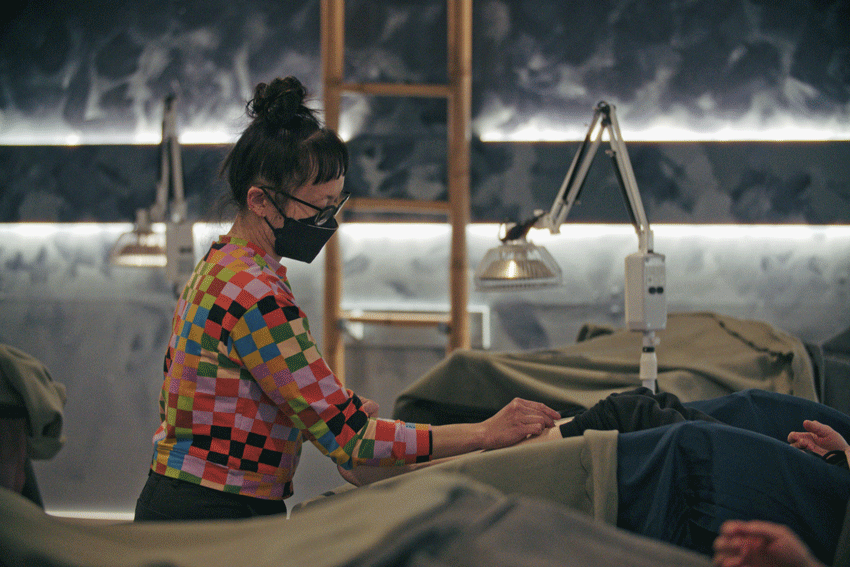
We can use subjective feedback from the patient like feelings of tenderness or pain when pressed at a possible image location, or our own observations of what an area feels like upon palpation (tactile investigation). We then chose other points and channels to strengthen the impact of our main imaged points, creating stabilizing structures out of the energetic channel relationships.
Each treatment is a creative fingerprint unique to what is going on for your body in that moment, and needs to be composed in the moment the way one would compose a poem.
This process of distal needling also allows for us to get around one aspect of the fear of needles – that being needled in a spot that already hurts is going to increase the pain before it reduces it.
Adding to this magic of distal acupuncture: clients getting to see the results we get from needling one area to treat another allows people to start thinking about their bodies and the world differently. If healing from non-local treatment is possible, then there must be more to our bodies and the laws that govern them than we have been taught in mainstream western culture.
We can learn to see our body as a whole connected system which cross-communicates with itself, and we can also begin to understand our body as part of a broader interconnected whole with the world around us.